
The Wall That Outlasted Everything
Jerusalem has been conquered, burned, rebuilt, and contested more times than almost any city in recorded history. Empires have risen and fallen within its walls. Armies have marched through its gates. Entire civilizations have left their mark on its stones and then disappeared.
And yet one structure remains.
Not because it was the most beautiful. Not because it was the most fortified. But because it has carried, for two thousand years, a weight of prayer that no army has ever been able to destroy.
The Western Wall is the last standing remnant of the retaining wall that surrounded the Second Temple in Jerusalem. It is, for millions of people around the world, the closest accessible point to the site where the Presence of God dwelt among His people.
And for believers of every background who take the scriptures seriously, standing before it, or having a prayer spoken there on their behalf, is not simply a historical or cultural experience.
It is a spiritual one.
What the Western Wall Actually Is
To understand the significance of the Western Wall, it helps to understand what it is and what it is not.
The Wall itself is not the Temple. It was never part of the Temple structure. It was the outer retaining wall built by Herod the Great to support the massive platform on which the Second Temple stood. When the Roman army destroyed Jerusalem in 70 AD, they demolished the Temple complex almost entirely. This wall, being exterior to the main structure, survived.
What stands today is roughly sixty meters of exposed ancient stone, with much more buried beneath the current ground level. The stones at the bottom of the Wall are among the largest ever quarried in the ancient world. Some weigh hundreds of tons.
For Jewish believers, the Wall represents the closest point to the Holy of Holies, the innermost chamber of the Temple where the Ark of the Covenant rested and where the Presence of God dwelled. Prayer at the Wall is understood as prayer in proximity to that holiness.
For faith-filled believers, the significance is layered differently, but no less real.
Why the Western Wall Matters to believers
Jesus walked in Jerusalem. He taught in the Temple courts that this very wall supported. The stones that pilgrims press their hands against today were laid during the lifetime of the disciples. The same wall that stood when Peter preached on the Day of Pentecost. The same stones that were standing when Paul walked through the city.
For a believer who holds the New Testament in one hand and the Old Testament in the other, the Western Wall is a physical point of connection to both.
It is where the story of Israel and the story of the Church intersect in stone.
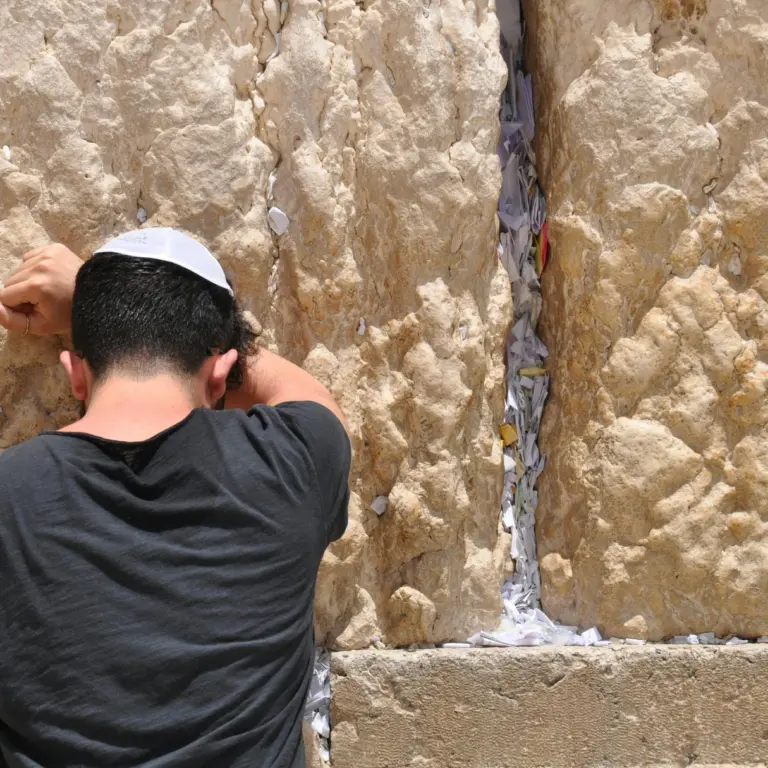
Beyond history, there is the reality of what has happened at this Wall over the centuries. Millions of prayers have been spoken here. The tradition of writing prayer requests on small pieces of paper and placing them in the cracks of the Wall is observed by people of every faith background. It is estimated that over a million notes are placed in the Wall each year.
There is something that the accumulated weight of all that prayer does to a place. Not in a superstitious sense. But in the sense that this has been, for centuries, a location where human beings have brought their deepest needs before God with complete honesty.
That is not nothing. That is, in fact, something that every believer can recognize and honor.
The Prayers That Have Been Spoken Here
To stand at the Western Wall is to stand in the middle of an unbroken chain of prayer that stretches back further than most people realize.
Jewish communities have gathered here to pray through exile, persecution, and return. They have mourned the destruction of the Temple. They have celebrated Shabbat and festivals. They have prayed for the sick, for the dead, for their children and their children’s children.
faith-filled pilgrims have come from every corner of the world and stood before these stones. Missionaries, pastors, ordinary believers, people who spent their life savings to make the journey and stood before the Wall weeping in ways they could not fully explain.
Leaders of nations have stood here. People with no public profile whatsoever have stood here. The Wall does not distinguish.
What it receives is prayer. And it has been receiving prayer, continuously, for longer than most of the institutions that shape our world have existed.
What Happens When You Pray at the Wall
People who have prayed at the Western Wall often describe the experience in terms that surprise even themselves.
Some describe a stillness that settles over them the moment they approach, a quieting of the internal noise that ordinarily does not stop. Others describe an unexpected surge of emotion, tears arriving before they have even formed a conscious thought about what they came to say.
Still others describe simply feeling heard. Not because of any mystical property of the stones themselves, but because there is something about standing in a place where so many have stood before in exactly the same posture of need that strips away pretense entirely.
You cannot stand at the Western Wall and perform. There is no audience for performance. There is only the Wall, and whatever you have brought with you.
That stripping away of performance is, for many believers, the most spiritually significant thing that happens there. Not an encounter with the extraordinary. An encounter with honesty.
And honesty before God, in any location, is where prayer actually begins.
The Tradition of the Prayer Notes
One of the most recognized practices associated with the Western Wall is the placing of prayer notes, known in Hebrew as kvitlach, into the crevices between the ancient stones.
The tradition is believed to have begun centuries ago, rooted in the understanding that the Wall is a place where prayers are received with particular attentiveness. Over time the practice has spread far beyond any single religious community. People of every background write their requests, fold the paper, and press it into the Wall.
The notes are collected twice a year and buried on the Mount of Olives, a practice that honors the sacred nature of the written prayers without simply discarding them.
For many people, writing a prayer note for the Wall is not a superstitious act. It is a physical, tangible expression of faith. It is saying, with your hands and not just your mind, that you believe your request matters and that you are bringing it somewhere specific.
There is something to be said for the physicality of that act. For most of human history, faith has been embodied. It has involved the movement of bodies toward holy places, the physical gesture of reaching out, the tangible act of leaving something behind.
The prayer note tradition honors that embodied quality of faith in a simple and accessible way.
What It Means to Have a Prayer Spoken at the Wall on Your Behalf
Not everyone can stand at the Western Wall in person. The distance is real. The cost of travel is real. The seasons of life that make a pilgrimage impossible are real.
But the prayers that need to be spoken are no less real for any of that.
When a member of the Blessing From Zion team stands at the Western Wall and speaks your name and your request aloud, they are doing something ancient. They are functioning, in a limited but genuine way, as a representative. Someone who can be present where you cannot. Someone who will stand in a holy place and bring your need before God with intention and care.
This is not a substitute for your own prayer life. It is an addition to it. A gift you can give yourself or someone you love. A moment of faith made tangible across any distance.
The Wall does not require you to be famous or wealthy or theologically sophisticated. It has received the prayers of the desperate, the grateful, the confused, and the faithful for centuries. It will receive yours as well.
Conclusion
The Western Wall is not magic. It is not a machine that processes prayer requests more efficiently than other locations. It is not a shortcut.
What it is, is a place. A real, physical, ancient place where the story of God and humanity has been unfolding for thousands of years. Where the intersection of covenant and longing has been lived out in stone and prayer and tears across more generations than any of us can fully comprehend.
For a believer who takes that story seriously, standing before it, or having a prayer spoken there, is a way of saying: I am part of this. My request belongs in this conversation. My name can be spoken in this place.
And it can.
Whatever you are carrying today, the Western Wall has held heavier things.
Bring it anyway.